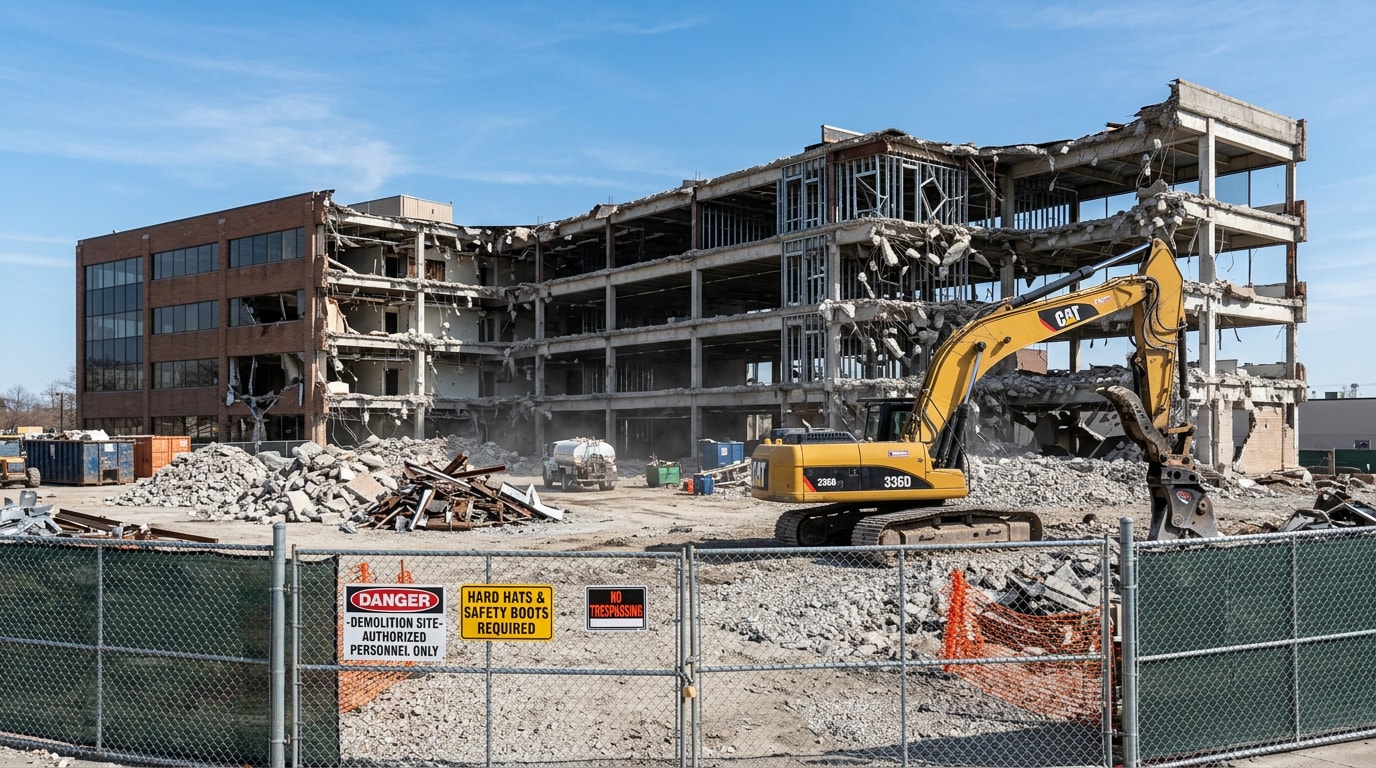
Commercial demolition contractors in Ooltewah, TN handle jobs ranging from a single retail strip-out to a full warehouse teardown off Apison Pike. The work looks simple from the curb, but permits, asbestos rules, and utility shutoffs can stall a project before an excavator ever shows up. Here's what separates a contractor who manages that process cleanly from one who leaves you with a stop-work order.
Key Takeaways
- Commercial demolition covers more than teardown. It includes selective demolition, interior strip-outs, and deconstruction.
- Every commercial demolition in Hamilton County needs a building permit plus a separate asbestos survey and Ten-Day Notification filed with the local Air Pollution Control Bureau.
- A licensed, insured contractor protects you legally and financially if something goes wrong on site.
- Full-service contractors handle debris hauling, recycling, and site grading, not just the knockdown.
- The biggest hiring factor: verified experience with commercial projects of similar size and scope to yours.
What Commercial Demolition Actually Covers
The right approach depends entirely on the project. A strip-mall owner renovating one unit needs something very different from a developer clearing a vacant warehouse.
Total demolition removes an entire structure down to the slab. This is typical for aging warehouses or buildings too far gone to renovate.
Selective demolition targets specific areas, like removing one wing of a retail center while the rest stays open for business.
Interior strip-outs gut everything inside a building, drywall, flooring, fixtures, mechanical systems, while keeping the shell intact. This is common when an office building is being repositioned for a new tenant.
Deconstruction is a slower, more selective dismantling process that salvages brick, timber, and fixtures for reuse. It fits owners prioritizing sustainability over speed. Large-scale implosion is rare locally and mostly reserved for sizable industrial structures.
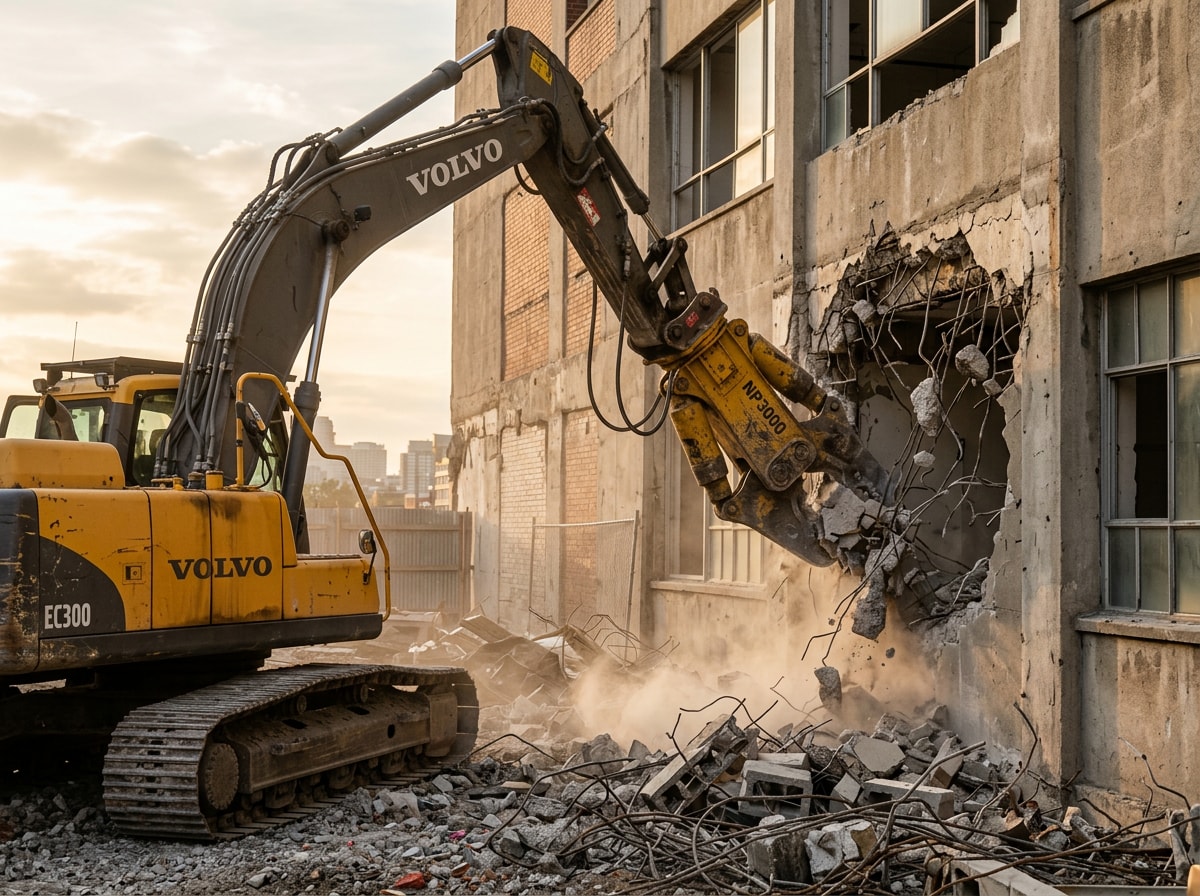
Matching the service type to the project is the first real conversation a contractor should have with you. If your project moves into regrading or new construction afterward, our Site Work and Excavation and Land Clearing teams pick up exactly where demolition leaves off.
Permits and Local Rules: What Hamilton County Requires
Commercial demolition in Tennessee is tightly regulated, and skipping steps isn't just risky, it's illegal.
In Hamilton County, a building permit is required for any new construction, alteration, addition, or repair to a structure. A building permit is required for any new, alteration, addition or repair to a structure. Demolition permits are issued separately from general building permits through the county's Building Inspection Department.
That's only half the paperwork. Any demolition or renovation at an institutional, commercial, or industrial building is also regulated by the federal Asbestos NESHAP. Any demolition or renovation operation at an institutional, commercial or industrial building is regulated by the Asbestos NESHAP, and the regulations require the owner or operator to notify the appropriate delegated entity before any demolition.
Locally, that notification goes to the Chattanooga-Hamilton County Air Pollution Control Bureau. A Ten-Day Notification must be filed at least ten days before work begins, and an asbestos survey is required for essentially every commercial demolition, regardless of the building's age. A Ten Day Notification form must be submitted at least ten days prior to the beginning of the project, and an asbestos survey is required for all demolitions, and most renovations, submitted with the Ten Day Notification.
The only real exception is a single-family home that was never used for commercial, office, or institutional purposes. The demolition of a single-family dwelling does not require an asbestos survey or a permit from the Air Pollution Control Bureau, providing it has not been used in the past for an institution, office, or commercial purpose. That exemption almost never applies to a commercial project.
The Air Pollution Control Bureau also charges a flat demolition permit fee tied to building size:
| Building Square Footage | Permit Fee |
|---|---|
| Up to 20,000 sq ft | $125 |
| 20,001 to 50,000 sq ft | $200 |
| Over 50,000 sq ft | $250 |
Building square footage up to 20,000 is $125, 20,001 to 50,000 is $200, and over 50,000 is $250. Most generic demolition guides skip this detail entirely, but it's the kind of line-item a contractor should already know cold when they quote your job. For general building-permit specifics, the Hamilton County Building Inspection Division publishes current forms and contact information, and the Chattanooga-Hamilton County Air Pollution Control Bureau handles the asbestos notification side.
If your project sits in Ooltewah or elsewhere in Hamilton County, confirm current submission requirements directly with the county. Timelines and documentation shift project by project.
The Demolition Process, Step by Step
Good outcomes are decided before the first excavator shows up.
- Site assessment. A competent person evaluates structural condition and surrounding properties. OSHA actually requires this:
prior to permitting employees to start demolition operations, an engineering survey shall be made, by a competent person, of the structure to determine the condition of the framing, floors, and walls, and possibility of unplanned collapse of any portion of the structure.
- Hazmat survey. This happens before anything else touches the structure, per the asbestos rules above.
- Utility disconnection. Gas, water, electric, and sewer lines get shut off and capped outside the building line, coordinated with local utility providers.
All electric, gas, water, steam, sewer, and other service lines shall be shut off, capped, or otherwise controlled, outside the building line before demolition work is started.
- Demolition execution. Mechanical equipment suited to the structure's size and materials does the actual work, governed by OSHA's Subpart T demolition standards.
OSHA created the Subpart T Demolition standards specifically for these operations because demolition carries hazards beyond standard construction work.
- Debris sorting and hauling. Materials get separated into metals, concrete, wood, general recyclables, and hazardous waste.
A small interior strip-out might wrap in a few days. A larger structure, especially one needing hazmat remediation, can stretch into weeks. Any contractor who quotes a firm timeline without inspecting the site first is guessing.
Where the Debris Actually Goes
Demolition, not new construction, generates the overwhelming majority of construction debris nationally. Demolition represents more than 90 percent of total C&D debris generation, while construction represents less than 10 percent. That's a big reason responsible contractors sort and divert material instead of hauling everything straight to a landfill.
Nationally, EPA's most recent full accounting shows roughly three out of every four tons of construction and demolition debris gets diverted to next-use markets like aggregate, fuel, or manufactured products rather than landfilled. Just over 455 million tons of C&D debris were directed to next use and just under 145 million tons were sent to landfills. Ask any contractor you're vetting what percentage of debris they typically divert. The answer tells you a lot about how they actually run a job site.
Need the ground prepped for what comes next? Our Site Preparation and Pads and Foundations crews regularly pick up a site the day after demolition wraps. Get a free estimate before you lock in a demolition date, so grading and foundation work can be scheduled back-to-back instead of sitting idle.
How to Choose the Right Commercial Demolition Contractor
Hiring the right team comes down to verifiable facts, not gut feeling.
Start with licensing. Confirm the contractor holds an active Tennessee contractor license, liability insurance, and workers' compensation coverage. A licensed, insured demolition contractor protects you from liability if an accident happens on your property.
Beyond credentials, ask these questions before signing anything:
- Can you show examples of commercial projects similar in size to mine?
- Will you provide a detailed written estimate covering labor, equipment, permits, hauling, and cleanup?
- Do you handle permitting, hazmat survey coordination, and debris removal in-house, or subcontract pieces out?
- Can you provide references from recent commercial clients?
- Is your crew trained on OSHA's demolition-specific standards, not just general construction safety?
Cost varies widely by project, but the main drivers stay consistent:
| Cost Factor | Why It Matters |
|---|---|
| Building size and structure type | More square footage and heavier materials mean more equipment time |
| Hazmat findings | Asbestos or lead abatement adds inspection, removal, and disposal costs |
| Site access | Tight urban lots or shared parking slow equipment staging |
| Utility complexity | Multiple service lines or nearby active utilities add coordination time |
| Debris hauling and recycling | Diverting material can lower disposal fees but adds sorting labor |
| Permits and notifications | Local fees plus the Ten-Day Notification timeline affect scheduling |
A full-service provider, one that manages demo, hauling, and grading under a single contract, typically means fewer coordination headaches and fewer surprise charges. We see this firsthand on site-work projects across Hamilton and Bradley counties: the jobs that stay on budget are almost always the ones where permitting and debris logistics were locked down before the first wall came down, not figured out mid-project.
Ready to move forward on the site work side? Request a free estimate and get a site-specific assessment. For a look at how civil work, grading, and foundations come together after demolition, our guide to civil works contracting in Hixson, TN walks through the full sequence. You can also browse recent work on our projects page or visit the Stessa Construction homepage for our full service lineup.
FAQ
How much does commercial demolition cost?
There's no reliable flat rate. Cost depends on building size, materials, hazmat findings, permit fees, and cleanup scope. A small interior strip-out costs far less than a full structural teardown with asbestos remediation. The only accurate number comes from a site-specific quote.
How is commercial demolition done?
Most commercial jobs use mechanical demolition: excavators, loaders, and specialized attachments that bring down structures efficiently. Selective demolition or deconstruction gets used instead when part of a building needs to stay intact or materials need to be salvaged.
How long does commercial demolition take?
Small retail interiors might finish in a few days. Larger industrial facilities can take several weeks once hazmat abatement and utility disconnection are factored in. Site access and building size drive the real timeline.
Do I need a permit to demolish a commercial building in Ooltewah?
Yes. You need a demolition permit through Hamilton County's Building Inspection Department, plus a separate asbestos survey and Ten-Day Notification filed with the Chattanooga-Hamilton County Air Pollution Control Bureau before work starts.
What is the Ten-Day Notification, and do I actually need one?
It's a required filing with the local Air Pollution Control Bureau, submitted at least ten days before demolition begins, regardless of whether asbestos is found. Nearly every commercial demolition needs one; only certain single-family homes are exempt.
Are there federal requirements for commercial demolition?
Yes. The Asbestos NESHAP under the Clean Air Act applies to demolition and renovation at institutional, commercial, or industrial buildings. Separately, OSHA's Subpart T sets safety standards for the demolition work itself, including a required engineering survey before work starts.
Who can legally perform commercial demolition in Tennessee?
A licensed, insured demolition contractor, not a handyman or DIY crew. Contractors working on commercial structures generally need an active Tennessee contractor license matched to the project's scope and value.